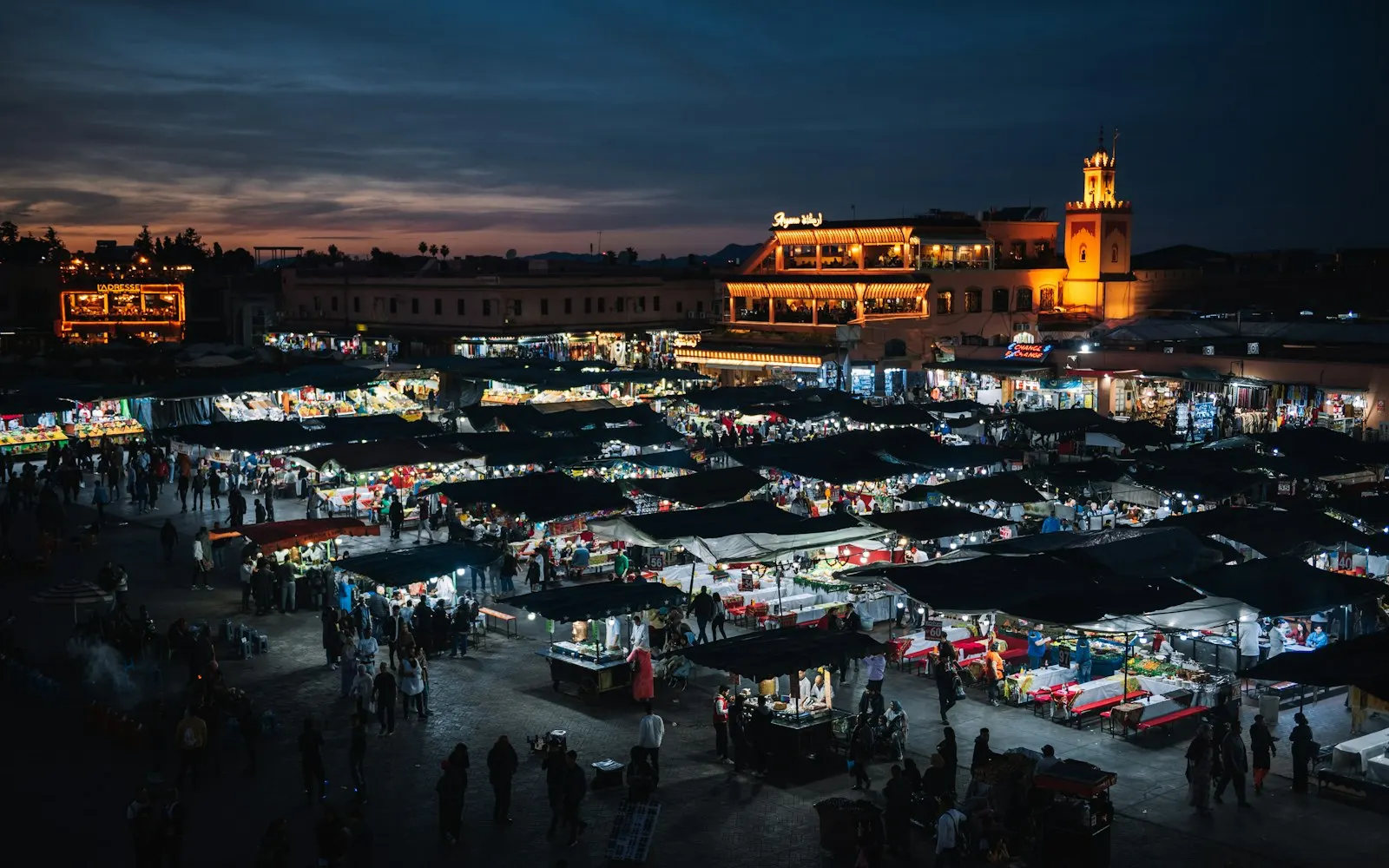
No place captures the energy of Marrakech like Jemaa el-Fna. By day it is a broad, sun-baked plaza of juice carts and snake charmers; by night it turns into a vast open-air restaurant wrapped in smoke, drums and storytelling. Whether you spell it Jemaa el Fna, Jamaa el Fna or Djemaa el Fna, it is the beating heart of the city.
Our guides cross the square almost every day, and this guide shares what we tell first-time visitors: where the square came from, why UNESCO honored it, how it changes from morning to midnight, what to eat, which scams to sidestep and how to enjoy it with confidence.
Jemaa el-Fna is the main square of Marrakech's medina, a public gathering place since around the 11th century and recognized by UNESCO in 2001 as a masterpiece of oral and intangible heritage. It is free to enter and open around the clock. Visit in the late afternoon and stay into the evening, when food stalls, musicians and storytellers fill the square.
Key takeaways
- Jemaa el-Fna is free, open 24 hours and sits a few minutes' walk from the Koutoubia Mosque.
- The square is best from roughly 5 pm to 11 pm, when the food stalls are set up.
- UNESCO recognized the square's oral traditions in 2001, a key inspiration for its intangible heritage program.
- Agree on prices before photos, henna or food to avoid surprise bills.
- Keep valuables zipped away; crowds attract pickpockets after dark.
- A rooftop café is the best spot to watch the square transform at sunset.
What Is Jemaa el-Fna?
Jemaa el-Fna is a large, irregular open square at the southern edge of the souks, within the UNESCO-listed medina of Marrakech. It has no fixed attractions and no ticket booth. Instead, it is a stage for street performers, vendors, cooks and thousands of locals and visitors who pass through each day.
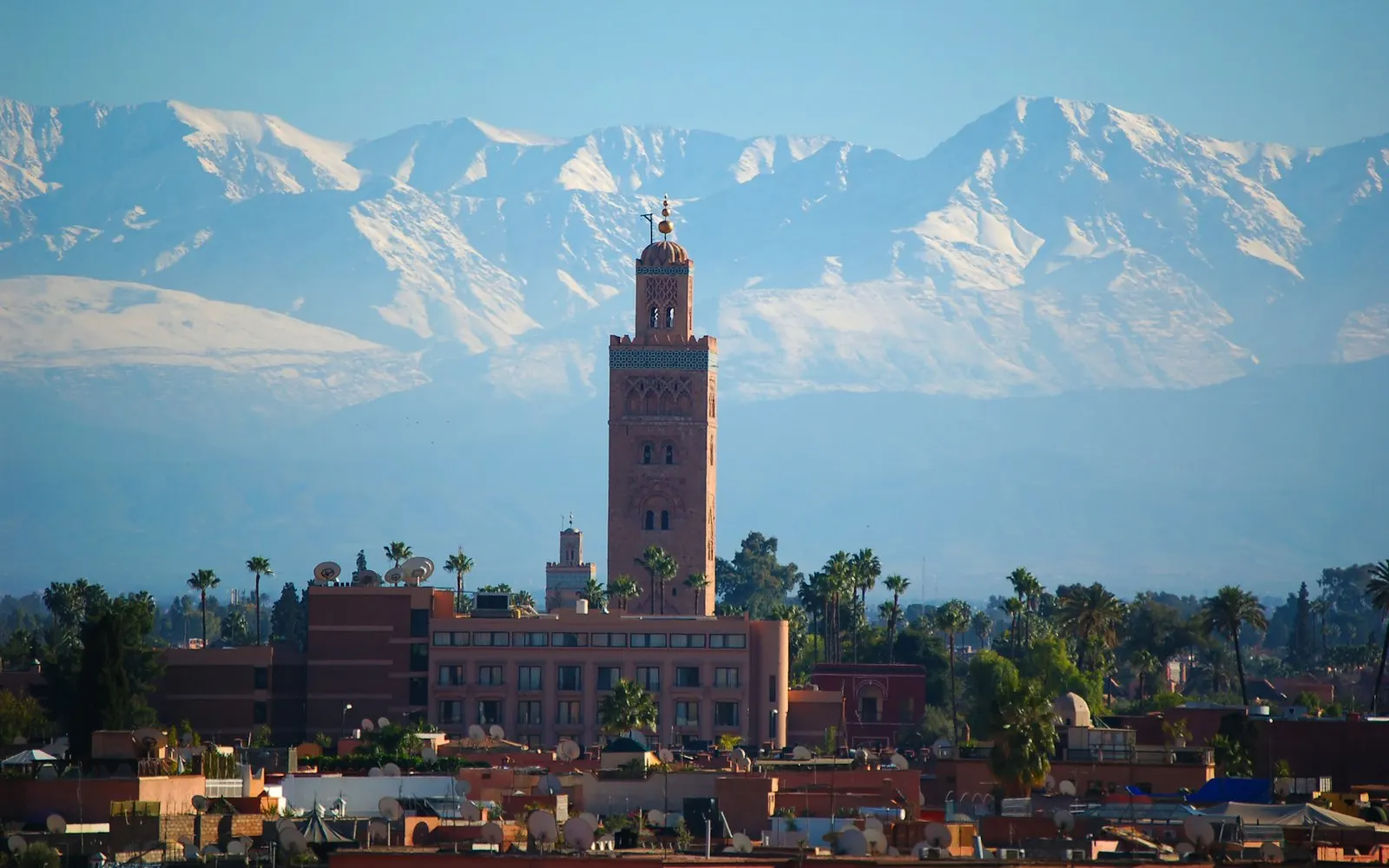
The square connects several key routes. The souks open to the north, the Koutoubia Mosque rises to the west, and taxis and calèches (horse carriages) gather along the southern edge. If you get lost in the medina, asking for "Jemaa el-Fna" will usually point you home.
A Short History of the Square
The square dates back to the founding of Marrakech by the Almoravid dynasty in the 11th century. For centuries it served as a marketplace, a meeting point for traders arriving from the Sahara and the mountains, and a public space for announcements.
What does the name mean?
The meaning is debated. "Jemaa" relates to gathering or a mosque, while "el-Fna" is often translated as "the end," "annihilation" or "courtyard." Popular explanations include "assembly of the dead," linked to public executions once held here, or a reference to a mosque project that was never completed. Historians do not agree on one answer.
Jemaa el-Fna and UNESCO
The medina of Marrakech was inscribed as a UNESCO World Heritage Site in 1985. In 2001, UNESCO proclaimed the "Cultural Space of Jemaa el-Fna Square" a Masterpiece of the Oral and Intangible Heritage of Humanity, after a campaign supported by the Spanish writer Juan Goytisolo, who lived in Marrakech. That recognition helped inspire the international convention on intangible heritage, and the square was later added to UNESCO's Representative List.
What UNESCO honored was not the space itself but its living traditions: the halqa (performance circles), storytellers, musicians, healers and poets who have passed their arts down through generations.
Jemaa el-Fna by Day vs Night
The square changes character completely over a single day. Here is what to expect.
| Time | What you'll see | Atmosphere | Tip |
|---|---|---|---|
| Morning (8-11 am) | Orange juice carts, a few vendors | Quiet, open space | Best for photos without crowds |
| Midday (11 am-4 pm) | Snake charmers, henna artists, water sellers | Hot, sparse shade | Walk through, don't linger |
| Late afternoon (4-6 pm) | Stalls being assembled, musicians arrive | Building energy | Grab a rooftop seat for sunset |
| Evening (6-11 pm) | Food stalls, storytellers, Gnawa music, crowds | Peak, festive | Eat, wander, keep valuables close |
| Late night (after 11 pm) | Stalls pack up, locals linger | Calmer | Head home via main lanes |
Daytime
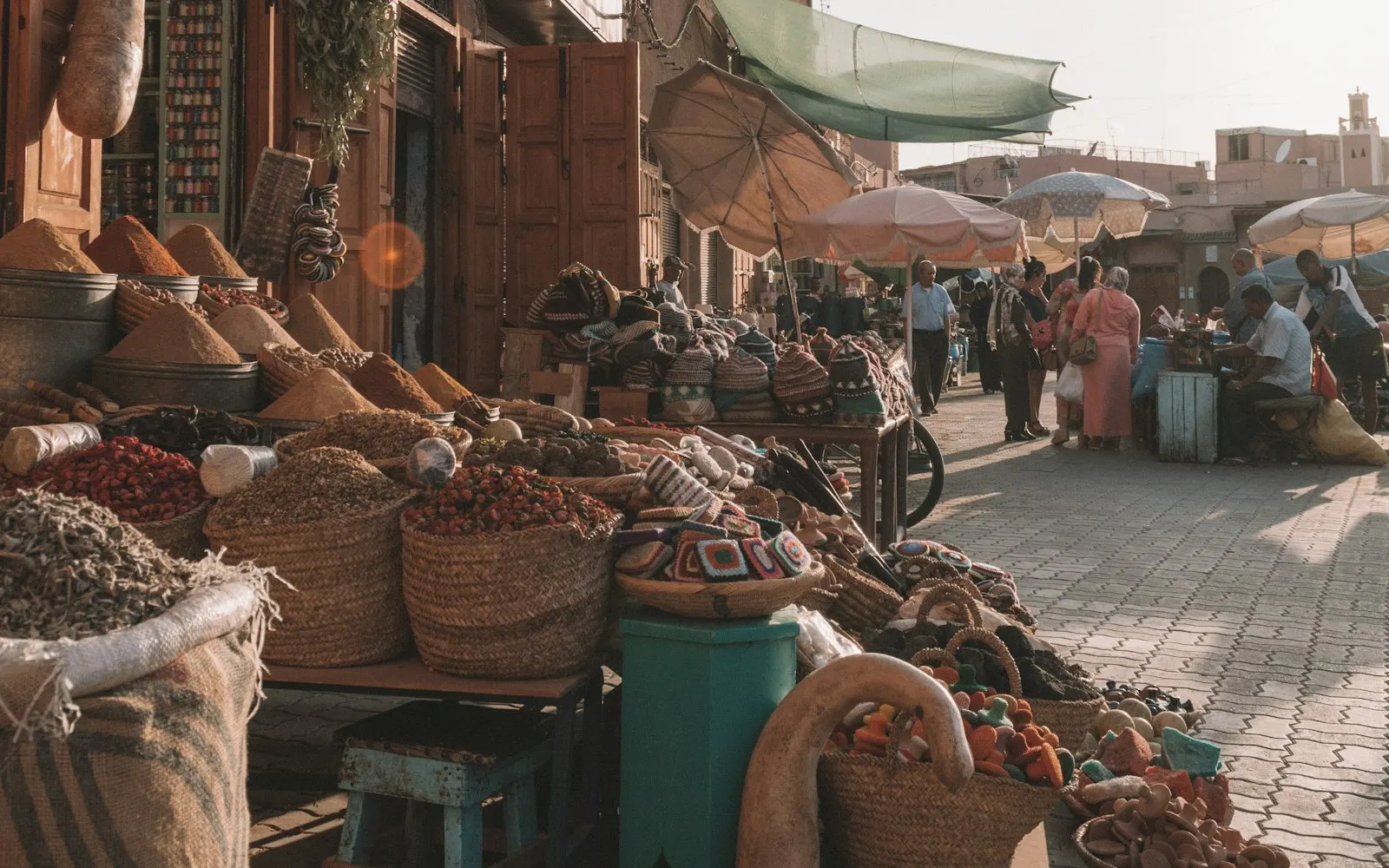
In the daytime, Jemaa el-Fna is mostly a place to pass through. Fresh orange juice carts line the square and are a quick, cheap refreshment. You will see snake charmers and men with Barbary macaques; we encourage visitors not to pay for animal photos, as these animals are often kept in poor conditions.
Nighttime
From late afternoon, rows of food stalls are wheeled in and smoke from the grills rises over the square. Circles of spectators form around Gnawa musicians with their iron castanets, storytellers, acrobats and boxing matches. This is when the square truly earns its fame.
Jemaa el-Fna Food Stalls: What to Eat
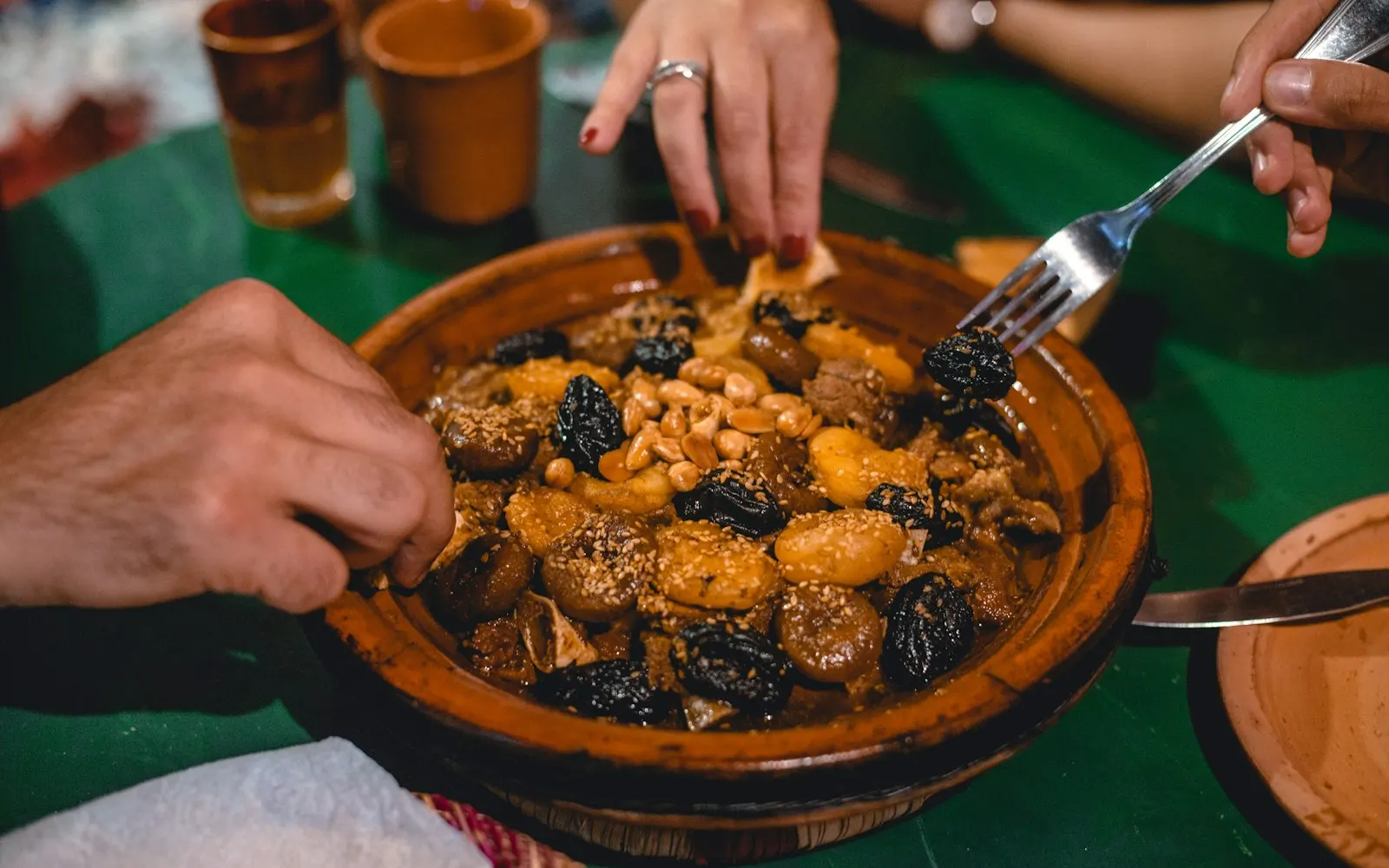
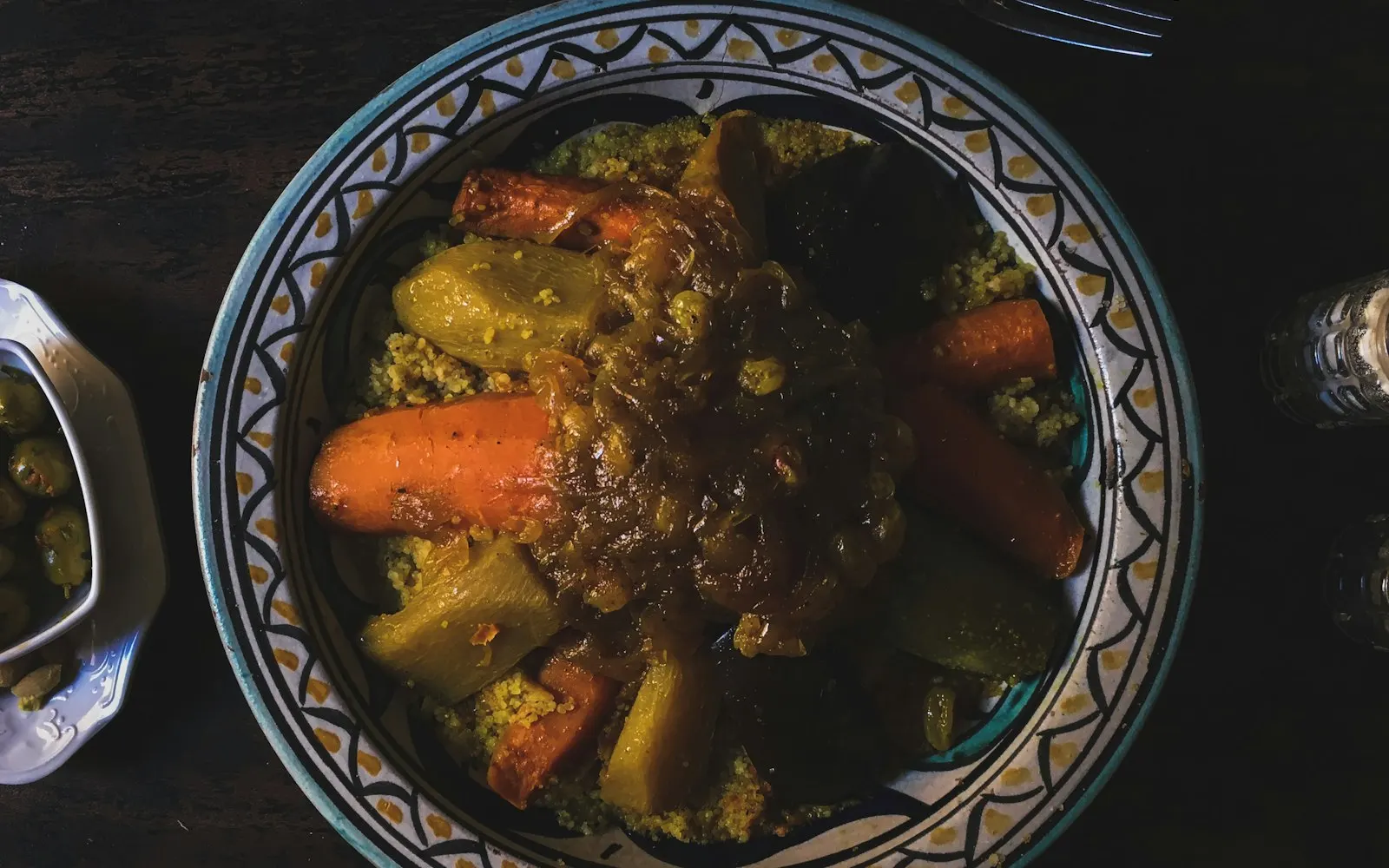
The evening food stalls are numbered and arranged in long rows, each with benches and a set menu. Here are dishes worth trying.
Classic dishes
- Harira: a tomato, lentil and chickpea soup, often eaten with dates.
- Grilled brochettes: skewers of lamb, beef or chicken, with Moroccan salads and bread.
- Snail soup: served in small bowls from carts, flavored with a mix of spices; popular with locals.
- Fried fish and calamari: at several seafood stalls.
- Tangia: a Marrakech specialty of slow-cooked beef, usually found at small eateries just off the square.
- Ginger and spice tea (khoudenjal): a warming drink sold with a dense spice cake.
How to choose a stall
Look for stalls busy with Moroccan families, where food turns over quickly. Check that prices are displayed or ask before you sit. Be aware that bread, olives and salads placed on your table may be added to the bill, so ask if they are included.
If you would like a local to guide your tasting, our night street food tour (3.5 hours, from €39) explores the square and the hidden food lanes around it. For a broader overview of dishes, read what to eat in Marrakech.
Common Jemaa el-Fna Scams and How to Avoid Them
The square is generally safe and full of families, but its popularity also attracts hustlers. Knowing the common tricks takes the stress away.
Photo fees
Performers, water sellers in red costumes and animal handlers expect payment for photos, sometimes asking for large amounts afterward. If you want a photo, agree on a price first, or simply keep your camera down.
Henna "gifts"
A henna artist may grab your hand and start drawing before you agree, then ask for a high fee. Politely but firmly pull your hand back. If you want henna, choose a reputable shop and agree the price in advance.
Fake guides and wrong directions
Someone may tell you a street is "closed" or offer to lead you somewhere, then demand money or bring you to a shop. Use an offline map, ask shopkeepers for directions, or book a licensed guide.
Stall touts
Food stall staff compete energetically for customers. It is fine to smile, say "no thanks" and keep walking until you find a stall you like.
Pickpockets
Crowds around performance circles are where pickpockets operate. Use a cross-body bag worn at the front and keep phones out of back pockets. For more advice, see our guide to whether Marrakech is safe.
Best Rooftop Views Over the Square
Watching sunset from above is a highlight of any Marrakech trip. Several cafés and restaurants around the edges of Jemaa el-Fna have terraces overlooking the square. Most expect you to buy a drink, usually mint tea or juice, in exchange for your seat.
Arrive around 30 to 45 minutes before sunset to get a front-row table, especially in spring and autumn. From up here you can watch the stalls light up as the call to prayer drifts over from the Koutoubia.
How to Get to Jemaa el-Fna
The square is central and easy to reach.
- From Gueliz (new town): about 10 minutes by taxi or a 30-minute walk along Avenue Mohammed V.
- From the airport: about 6 km, roughly 15 to 20 minutes by taxi depending on traffic. Our guide to getting from Marrakech airport to the medina explains your options.
- From medina riads: most are within a 5 to 20-minute walk.
Taxis cannot drive into the square itself, so drivers usually stop near the Koutoubia or on the southern side.
Practical Tips for Visiting
- Carry small change: coins and small notes make tipping performers and buying juice easier.
- Tip performers fairly: if you stop to watch a show, a few dirhams is appropriate.
- Dress comfortably and modestly: covering shoulders and knees is respectful and helps you blend in.
- Visit more than once: come in the morning for calm and again at night for the full spectacle.
- Start with a guide: a medina walking tour (from €25) on your first day helps you find your way to and from the square.
For other ideas nearby, our list of the best things to do in Marrakech includes palaces and gardens within walking distance.
Conclusion
Jemaa el-Fna is noisy, chaotic and unforgettable, a living piece of heritage that has hosted storytellers and traders for nearly a thousand years. Visit at sunset, eat where the locals eat, agree on prices before you pay and you will experience the square at its best.
Want to explore it with someone who knows every stall? Message our team on WhatsApp to book a food tour or medina walk, with hotel pickup, payment on the day and free cancellation.